
Key Takeaways
- Who Ran the Route Decides the Rules: Oklahoma trash is collected by city and county sanitation crews, by private haulers working under municipal contracts, and by private companies serving their own customers. If a government employee was driving within the scope of the job, the claim generally runs through the Governmental Tort Claims Act. If a private hauler was driving, it is generally an ordinary negligence case. The two paths carry different defendants, different damage rules, and very different deadlines.
- The Government Clock Is Short: A claim under the Governmental Tort Claims Act is generally barred unless written notice is presented within one year after the loss under 51 O.S. § 156, and suit generally must follow within 180 days after the claim is denied or deemed denied under 51 O.S. § 157. That is far shorter than the two-year period most injury claims get.
- A City Contract Does Not Settle Employee Status: The GTCA's definition of "employee" in 51 O.S. § 152 generally excludes independent contractors and their employees. A genuinely independent private hauler is generally evaluated under ordinary negligence law. The contract, the workers' actual roles, and any separate claim against a public entity still need review; do not assume the shorter government deadlines are irrelevant while that identity question is unresolved.
- The Crash Pattern Is Distinctive: Garbage trucks work residential streets at low speed with constant stops, frequent backing, early-morning light, and workers on and around the vehicle. The Federal Motor Carrier Safety Administration warns that large trucks have large blind spots, long stopping distances, and make wide turns — and on a collection route, those limits meet children, cyclists, and backing maneuvers block after block.
After a garbage truck accident in Oklahoma, identify who operated the truck: a public sanitation crew or a private hauler. Some Oklahoma communities collect trash with their own sanitation crews; many others contract collection out to private haulers; and in some areas private companies serve their own subscribers directly. The answer changes everything that follows. A crash with a city-operated truck generally falls under the Governmental Tort Claims Act, with a written-notice deadline that can come due within one year. A crash with a private hauler is generally an ordinary negligence case against the company, on the usual two-year schedule. This article explains how to tell the paths apart, what each one requires, and why the distinctive way garbage trucks operate shapes the evidence in these cases.
This article is general legal information, not legal advice. Which rules govern a particular crash — and especially which deadline applies — are fact-specific questions that need review by an attorney on your actual facts, and they need that review early.
Why Garbage Truck Crashes Are Their Own Category
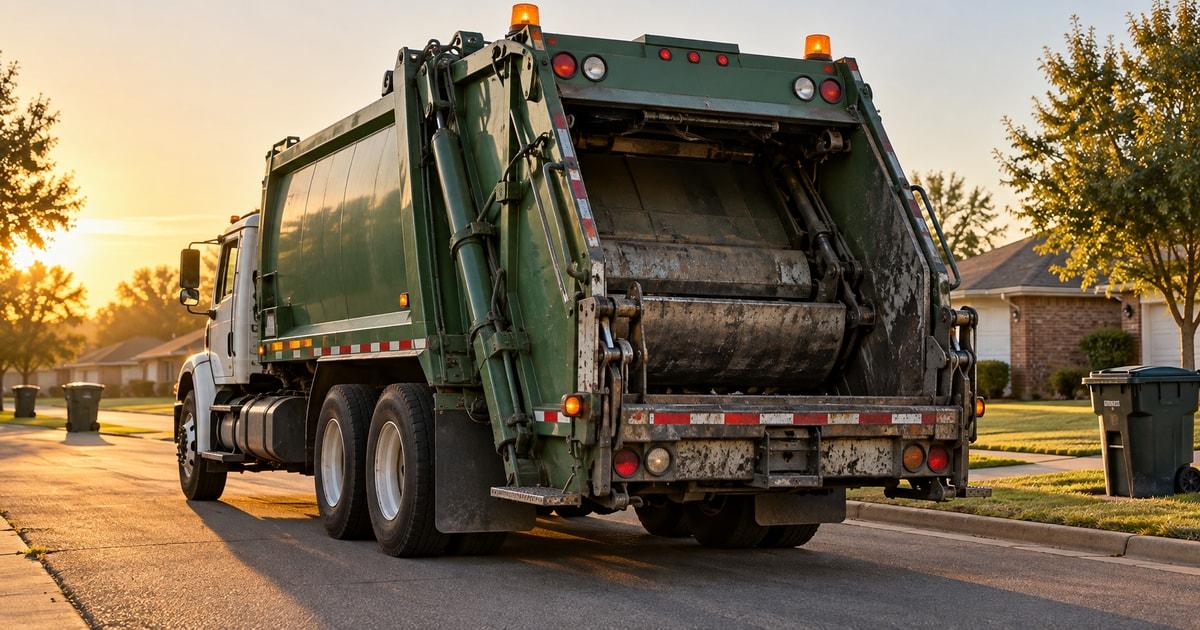
A refuse truck spends its working day doing things no other heavy truck does. It stops every few yards, pulls back into moving traffic hundreds of times a shift, backs down dead-end streets and alleys, makes wide swings into narrow residential corners, and does much of this in early-morning light with workers stepping on and off the vehicle. Each of those movements is routine for the crew and invisible to almost everyone else on the street.
The vehicle itself compounds the problem. The Federal Motor Carrier Safety Administration's public guidance on sharing the road warns that large trucks have large blind spots, long stopping distances, and make wide turns, and offers drivers a simple test: if you cannot see the driver's face in the truck's mirror, the driver cannot see you. A rear-loading refuse truck adds obstructions that guidance does not even contemplate — a body that can block much of the rear view, hoppers and lifting arms in motion, and a collection route where workers and pedestrians may be near the vehicle. Potential crash patterns include backing impacts, pull-away impacts into passing cars and cyclists, wide-turn conflicts, and strikes on people outside the driver's view.
None of that decides fault by itself. It defines the questions: what could the driver see, what did the truck's systems record, what route and schedule pressures existed, and what the operator's own safety procedures required. Some collection trucks, public and private, are equipped with cameras or telematics, though federal truck-safety rules do not require cameras on heavy trucks. Where that equipment exists, its data can make or break the proof. How to lock that evidence down before it is overwritten is covered in our guide to preserving trucking evidence.
The First Question: Who Runs Your Route
Before anything else, a garbage truck case has to identify the operator, because Oklahoma law splits sharply on the answer.
If the truck was operated by a city, county, or public trust qualifying under the GTCA's definitions and the driver was a government employee acting within the scope of employment, the claim generally runs through the Governmental Tort Claims Act. Under 51 O.S. § 153, the state and its political subdivisions are liable for the torts of employees acting within the scope of employment — but only subject to the Act's limits and exceptions, and that liability is exclusive. The suit generally must name the government entity itself: under 51 O.S. § 163, an employee acting within the scope of employment is not named as a defendant.
If the truck was operated by a private company, the GTCA generally does not apply — even when the company was collecting under a contract with the city. The Act's definition of "employee" in 51 O.S. § 152 generally does not cover a person or entity acting as an independent contractor or an employee of an independent contractor. A contract to run the city's routes does not, by itself, turn the hauler's driver into a city employee; the statutory definitions and the actual relationship matter, and borderline arrangements need case-specific review. When the private path applies, the case looks like other truck litigation: the driver's negligence, the company's responsibility for its driver, and the company's own hiring, training, maintenance, and route-design decisions. Our overview of who can be sued after an Oklahoma truck wreck maps that defendant landscape.
Sorting this out is not always obvious from the curb. The truck's markings may carry a city's name, a contractor's name, or both; a route may have changed hands recently; and some crashes involve a mix — a public crew, a contractor's vehicle, a leased truck. Police reports, the entity's own contracts and franchise ordinances, and early preservation letters answer the question. The point is to answer it fast, because the deadlines below do not wait for certainty.
If It Was a Government Truck: The GTCA Clock
The Governmental Tort Claims Act replaces the ordinary lawsuit timeline with a notice-and-denial sequence, and the first deadline is the one that catches people.
Written notice of the claim generally must be presented within one year after the loss. Under 51 O.S. § 156, a claim is forever barred unless notice is presented within one year after the loss occurs. Notice against the state is filed with the Office of the Risk Management Administrator and counts when received; notice against a city, county, or other political subdivision is filed with the office of the clerk of its governing body. The statute's exceptions are narrow — the notice period excludes up to ninety days of incapacity caused by the injury, and a wrongful-death claim carries its own one-year period running from the death — and no one should plan around an exception applying. A child's age does not extend the year: in Crawford v. OSU Medical Trust, 2022 OK 25, 510 P.3d 824, the Oklahoma Supreme Court held that the incapacity provision does not reach minority and that the general tolling statute for legal disabilities, 12 O.S. § 96, does not apply to GTCA notice. Our GTCA and sovereign immunity guide walks through the framework, and our tort claims resource page covers the mechanics of the notice itself.
Filing notice starts a second clock, not a resolution. Under 51 O.S. § 157, a claim the entity does not approve in full within ninety days is generally deemed denied — and an earlier actual denial can start the next period sooner. Suit generally must be filed within 180 days after the denial. Settlement talk does not move either date unless the extension is agreed in writing, and even a written agreement cannot push the filing deadline past two years from the loss.
The GTCA also changes what a claim can recover. 51 O.S. § 154 caps recovery at dollar limits that depend on the kind of loss, the governmental defendant, and the date of the accident — the Legislature amended the caps in 2025, so which figures govern a particular crash needs current, case-specific review — and the same section bars punitive or exemplary damages against the state and political subdivisions entirely. Dealing with a government entity's insurer and claims process has its own traps, covered in our guide to insurance bad faith in government claims.
One more wrinkle is worth knowing: the federal motor carrier safety regulations generally do not apply to transportation performed by a state or political subdivision, under 49 C.F.R. § 390.3T(f)(2). That exception has limits. The federal commercial driver's license rules in Part 383 apply to government employers and their drivers (49 C.F.R. § 383.5 defines "employer" to include a State or political subdivision), and the drug and alcohol testing rules in Part 382 generally reach employers of drivers subject to those CDL rules (49 C.F.R. § 382.103(a)). Beyond those, a city sanitation truck is judged mainly by ordinary negligence standards and the operator's own policies.
If It Was a Private Hauler: An Ordinary Negligence Case
When a private company's truck caused the crash, the claim generally proceeds like other Oklahoma injury cases. The company is generally responsible for its driver's on-the-job negligence. Separate claims against the company for negligent hiring, training, supervision, or retention can be limited if it admits the driver was acting within the scope of employment: under Jordan v. Cates, 1997 OK 9, 935 P.2d 289, such claims may be treated as superfluous, and federal courts in Oklahoma have divided over how far that rule reaches. Negligent entrustment survives such an admission under Fox v. Mize, 2018 OK 75, 428 P.3d 314. Claims about the company's own maintenance and routing decisions need separate analysis. The GTCA's caps and its bar on punitive damages do not apply. Oklahoma's general damages statutes still do: for injuries on or after September 1, 2025, 23 O.S. § 61.3 generally caps noneconomic damages at $500,000; the cap rises to $1,000,000 for certain permanent mental injuries, does not apply to certain permanent and severe physical injuries, and does not apply where the factfinder finds reckless disregard, gross negligence, fraud, or intentional or malicious conduct by clear and convincing evidence. Whether any punitive claim is viable depends on the conduct the evidence shows, not on the label "trucking company."
The filing deadline is also different. Oklahoma's general limitations period for most injury claims is two years under 12 O.S. § 95(A)(3) — with exceptions and traps, including wrongful-death and minors' rules, collected in our statutes of limitations guide. Two years is more room than the GTCA allows, but the evidence in a garbage truck case does not keep for two years: camera footage cycles, telematics data is overwritten, and route records get archived. The practical deadline is set by the evidence, not the statute.
Which safety rules governed the operation needs vehicle-by-vehicle review rather than assumption. Whether a particular private refuse operation is subject to the federal motor carrier safety regulations, Oklahoma's intrastate motor carrier rules, or both depends on the vehicles, cargo, and routes involved; the same question comes up with construction hauling, and our dump truck accidents guide explains how the interstate, intrastate, and exempt categories sort out. What a claimant should not do is accept a hauler's assertion that no rules applied — that is a legal conclusion to test, not a fact to concede.
Backing Crashes, Pedestrians, and the Proof
The hardest garbage truck cases are the ones where the vehicle met a person: a child near a stopped truck, a cyclist alongside a pull-away, a neighbor behind a backing maneuver, a crew member crushed at the hopper. (A worker injured on their own crew usually has a workers' compensation claim against the employer rather than a lawsuit, though claims against other responsible parties can survive — another reason the operator question matters.)
In these cases, fault is built from the operation's own records. What the route sheet demanded, what the backing policy required, whether a spotter was used, what the cameras captured, what the telematics logged about speed and movement, and what the driver could actually see from the mirrors and monitors — those facts exist in the operator's hands and rarely surface on their own. A prompt preservation demand, covered in our evidence preservation guide, is the difference between proving what happened and arguing about it.
Expect comparative-fault arguments in response: the pedestrian stepped out, the cyclist was in the blind spot, the other driver tried to pass a working truck. Oklahoma weighs those arguments under its comparative negligence system, where a claimant's recovery is reduced by their share of fault and barred only if that share exceeds the combined fault of the other parties — the framework is explained in our guide to Oklahoma's 51 percent bar. A working truck's presence on a residential street is ordinary and foreseeable; the legal question is whether the operator used reasonable care, and the industry's own safety practices can be evidence of what reasonable care required.
Frequently Asked Questions
Can I sue the city if its garbage truck hit me in Oklahoma?
Generally yes, but through the Governmental Tort Claims Act rather than an ordinary lawsuit. The claim proceeds against the city itself — not the driver — and it generally requires written notice to the clerk of the city's governing body within one year after the loss under 51 O.S. § 156, followed by suit within 180 days after the claim is denied or deemed denied under 51 O.S. § 157. Recovery is capped at statutory limits that depend on the loss, the defendant, and the accident date, and punitive damages are not available against the government. Miss the notice deadline and the claim is generally barred, so the safe course is to get advice well inside the first year.
What if the truck belongs to a private company the city hired?
A private company acting as an independent contractor is generally evaluated under ordinary negligence law. The GTCA's employee definition generally excludes independent contractors and their workers, but a municipal contract alone does not settle the actual relationship or any separate claim against the city. Review the contract, who employed and controlled the crew, and each party's alleged conduct. Until a possible government claim is ruled out, preserve the shorter GTCA notice deadline rather than assuming every claim follows the private-company timetable.
How long do I have to bring a garbage truck accident claim in Oklahoma?
It depends on the operator, which is why identifying the operator is step one. If a government employee was driving within the scope of the job, written notice is generally required within one year after the loss, and suit must follow within 180 days after denial. If a private hauler was responsible, most injury claims carry a two-year limitations period under 12 O.S. § 95(A)(3). Each track has its own narrow exceptions — on the government side, up to ninety days of injury-caused incapacity and a separate one-year notice period for wrongful death; on the private side, rules such as the legal-disability tolling statute that can apply to minors — but none should be counted on without advice. A child's age does not extend the one-year GTCA notice period (Crawford v. OSU Medical Trust, 2022 OK 25). When the operator is unclear, treat the shorter government deadline as the one that controls until an attorney confirms otherwise.
A garbage truck backed over someone. Who is responsible?
Potentially several parties, depending on the facts: the driver's operation of the truck, the company or entity that set the backing procedures and route, and anyone whose equipment or decisions contributed. Backing is a well-recognized hazard in refuse collection, and operators may use cameras, alarms, spotters, or route designs to reduce it; whatever the operator used or required is part of the case, which is why its own records are the center of it. If the person injured was a member of the crew, workers' compensation rules generally govern the claim against the employer, while claims against other responsible parties need separate analysis. Either way, any camera footage and telematics data should be preserved immediately.
Talk to an Oklahoma Truck Accident Lawyer
Whether a city crew or a private hauler operated the truck can change the notice and filing requirements, potential defendants, and applicable damage limits. Addison Law Firm's trucking accident practice can help identify the operator, send prompt preservation demands, and track the deadline that applies.
Contact us for a free consultation.
This article is general information, not legal advice, and does not create an attorney-client relationship.