
Key Takeaways
- Who Ran the Truck Shapes the Case: A dump truck may be run by an interstate carrier, an Oklahoma-only hauler, a contractor hauling its own material, or a public road or utility crew. That can change which safety rules applied, who can be sued, and which deadlines control. Ownership alone does not settle it.
- Government Claims Have Their Own Deadlines: When an Oklahoma state or local government employee was driving within the scope of the job, the Governmental Tort Claims Act generally requires written notice within one year under 51 O.S. § 156, then suit within 180 days after actual or deemed denial. Denial can occur before 90 days. Exceptions and written extensions need case-specific review.
- Oklahoma-Only Hauls Can Still Be Regulated: 47 O.S. § 230.15 directs the Department of Public Safety to set hours rules built on the federal framework, with a 12-hour limit for qualifying vehicles engaged solely in intrastate commerce that are not transporting hazardous materials. A trip entirely inside Oklahoma can still be interstate commerce. Coverage and exceptions matter.
- Backing Rules on Construction Jobsites: On off-highway construction jobsites not open to public traffic, 29 C.F.R. § 1926.601(b)(4) bars an employer from using a covered vehicle with an obstructed rear view unless it has a reverse alarm audible above the surrounding noise or is backed only when an observer signals that it is safe.
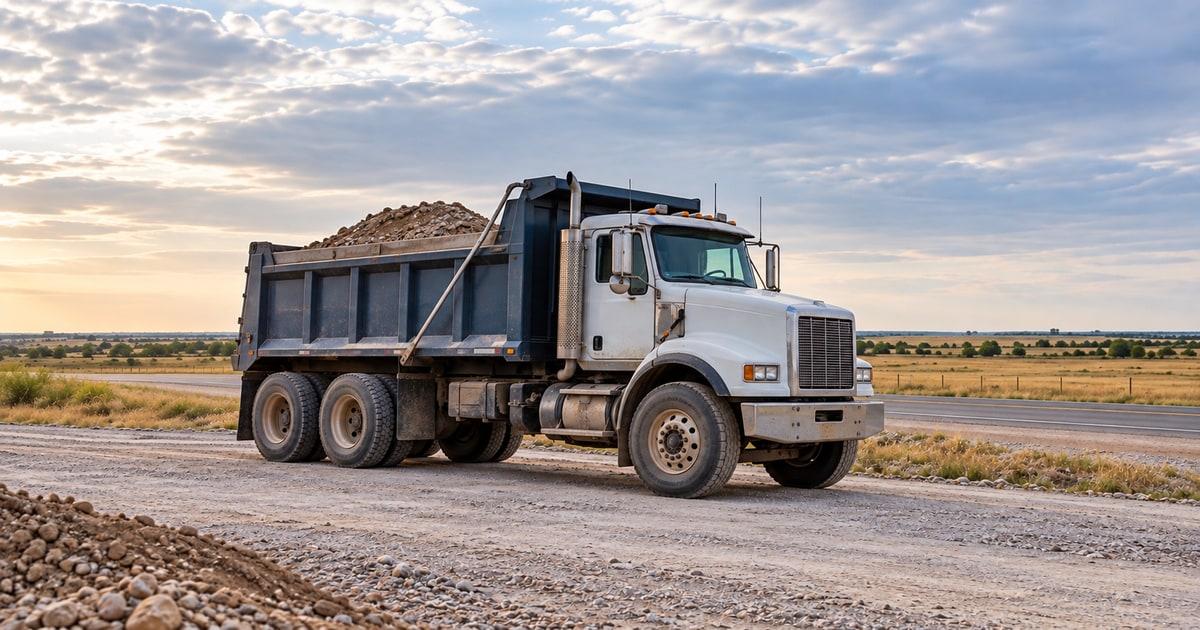
Who is liable after a dump truck accident in Oklahoma can turn on who was running the truck and why. Gravel and aggregate trucks can make repeated runs between pits, plants, and job sites without leaving Oklahoma. The operator may be a hauling company, a construction contractor, or a public road crew. Those facts help identify the safety rules and potential defendants; ownership alone does not establish liability. When an Oklahoma government employee was driving within the scope of the job, notice deadlines can come due well before the usual two-year injury-claim deadline.
This article is general legal information, not legal advice. Which rules governed a particular truck, driver, and route — and which deadlines apply to a particular claim — are fact-specific questions that need review by an attorney on your actual facts.
Why Dump Truck Crashes Are Their Own Category
The work a dump truck does shapes the ways it can cause harm. These trucks carry dense loads of sand, gravel, rock, asphalt, and demolition debris, so weight and load behavior are central to these cases. Loading and dumping involve backing, turns across traffic near site entrances, and raised beds operating around people and overhead hazards. On local roads and in work zones, the truck may be close to passenger vehicles, workers, and pedestrians.
None of that changes the basic negligence framework in a lawsuit: a crash still has to be traced to someone's failure to use reasonable care. What it changes is where the evidence lives and who the responsible parties may be. A good first question is simple: whose truck was it, and what was it doing that day?
Which Safety Rules Applied: Interstate, Intrastate, or In-House
If the dump truck was a covered commercial motor vehicle operating in interstate commerce, the Federal Motor Carrier Safety Regulations generally apply, subject to exceptions and part-specific coverage rules. Our guide to who can be sued after an Oklahoma truck wreck walks through that framework. A haul that never crosses a state line can still be interstate commerce if it is one leg of a shipment that began or will end outside Oklahoma, under 49 C.F.R. § 390.5T.
For genuinely intrastate operations, Oklahoma's rules need separate review. Under 47 O.S. § 230.15(D), state law directs the Department of Public Safety to set driving-hours limits consistent with the federal hours-of-service rules. The statute directs those rules to allow up to 12 hours of driving in a work period for qualifying vehicles engaged solely in intrastate commerce that are not transporting hazardous materials. It also bars adoption of a rule enforcing the federal 30-minute break requirement against a driver or carrier engaged solely in intrastate commerce. Its eight-consecutive-hours-off-duty provision is a general floor, not a blanket intrastate exemption from other rest requirements.
The Department of Public Safety's current rules must be checked for the particular vehicle and operation. The truck's weight, use, operator, cargo, and trip must be checked against the applicable rules; being an in-state dump truck does not establish that every federal rule applies. Federal hours rules also have exceptions, including for qualifying short-haul operations and drivers used primarily to haul construction materials and equipment. The federal 11-hour driving limit, the qualifying Oklahoma 12-hour limit, and an exemption are different possibilities, not proof that the driver violated any of them.
The truck may instead be a construction company's own equipment or a public road or utility crew's truck. A contractor hauling its own material can still be responsible for its driver's negligence and its own hiring, training, and maintenance decisions. The federal motor carrier safety regulations generally exempt transportation performed by the federal government, a state, or a political subdivision under 49 C.F.R. § 390.3T(f)(2). If an Oklahoma state or local employee was driving within the scope of the job, the claim against the government generally runs through a different statute, covered below. That does not move claims against other defendants into the same framework.
Who Can Be Liable
The potential defendant list starts with the driver and the company whose business the truck was serving. A hauling company may be liable for its driver's negligence and for its own decisions about hiring, training, dispatch, and maintenance. A general contractor or site operator may share responsibility for how trucks were routed, staged, and flagged at a job site, subject to defenses such as workers' compensation immunity discussed below. We cover site-control issues in our article on construction zone accidents in Oklahoma. Aggregate hauling can involve owner-operators or leased trucks, which adds relationships to investigate, not automatic liability for every owner. Sorting those out takes contracts, dispatch records, and insurance documents.
Two recurring dump-truck problems deserve their own mention, and each has a dedicated guide. Overloading — running heavier than the limits or loading badly — is covered in our article on overloaded trucks and cargo violations. Spilled and escaping loads, including the gravel-on-the-windshield cases and debris left in the roadway, are covered in our guide to fallen cargo and road debris crashes, which explains Oklahoma's load-securement rule and the federal securement standards. If your crash fits one of those patterns, those articles carry the detailed rules; this one is about the liability map around the truck itself.
When a City, County, or State Truck Is Involved
State, county, and city road and utility crews use dump trucks, but the truck's title does not decide whether the Governmental Tort Claims Act applies. The Act generally covers torts of Oklahoma state or local government employees acting within the scope of employment, subject to its limits and exceptions. When it applies, the claim generally must be brought against the government entity, not the within-scope employee, under 51 O.S. § 163(C). Federal, tribal, private-contractor, and outside-scope situations require separate analysis. A contractor working on a public project is not automatically a government employee; the statutory definitions and the actual relationships matter.
Written notice generally must be presented within one year after the loss under 51 O.S. § 156. A State claim goes to the Office of the Risk Management Administrator of the Office of Management and Enterprise Services; a political-subdivision claim goes to the office of the clerk of its governing body. A mailed State claim counts on receipt, not mailing. Narrow exceptions include up to 90 days of incapacity caused by the injury and a one-year notice period from death for a wrongful-death claim. Being a minor does not by itself extend the notice period.
A claim not approved in full within 90 days is generally deemed denied, but an earlier actual denial can start the lawsuit clock sooner. Suit generally must be filed within 180 days after actual or deemed denial under 51 O.S. § 157; the government's notice obligations can affect that calculation. Settlement talks alone extend neither the denial date nor the filing deadline. Changing either requires a written agreement, and an agreed extension of the time to sue cannot run beyond two years from the loss. Do not assume everyone gets 90 days followed by another 180.
When the Act applies, it also limits recovery. 51 O.S. § 154 sets dollar limits that depend on the kind of loss, the governmental defendant, and the accident date, and it bars punitive damages against the State and political subdivisions. Our sovereign immunity and GTCA guide explains the broader framework, including functions exempt from liability entirely. If an Oklahoma public employee may have been driving within the scope of the job, get advice before the one-year notice deadline rather than relying on the usual two-year injury period.
Backing Accidents, Raised Beds, and Job Sites
A loaded truck backing across a site can cause serious injuries even at walking speed. On off-highway construction jobsites not open to public traffic, 29 C.F.R. § 1926.601(b)(4) bars an employer from using motor vehicle equipment with an obstructed rear view unless it has a reverse signal alarm audible above the surrounding noise or is backed only when an observer signals that it is safe. Equipment covered by § 1926.602 follows that section instead, including its similar rule for off-highway trucks and earthmoving equipment. These Occupational Safety and Health Administration rules govern employers' jobsite duties; their role in an injury lawsuit depends on the facts and parties. The alarm's condition, whether an observer signaled, and the site's backing plan are facts to preserve, not automatic proof of civil liability.
Raised beds create another set of hazards: beds lifted into power lines or overhead structures, trucks moving with the bed up, and loads released where people or vehicles were below. Those events call for investigating site operations as well as driving decisions. A contractor or site operator may belong in that investigation, but an injured worker must also account for workers' compensation immunity before treating that party as a defendant.
If you were injured on the job, workers' compensation is generally the exclusive remedy against your own employer. Under 85A O.S. § 5, that protection also reaches certain related parties, including co-workers, the employer's prime contractor, and in some situations a general contractor that provided comp coverage to a subcontractor. A separate company on the same job that is not your employer and does not stand in the position of an intermediate or principal employer can generally face a third-party claim, subject to other statutory protections. The contracts, coverage arrangements, and loaned-servant relationships matter; a different company name alone does not settle it. Our workers' comp exclusivity article explains the choice between the comp system and court against an employer.
An owner-operator who owns or leases and actually drives a truck for hire can also fall outside the workers' compensation definition of employee when the contracting party is not the truck's lessor, unless the owner-operator elects coverage as a sole proprietor under 85A O.S. § 2(18)(b)(8). That is another reason to check the contracts and coverage rather than assume every injured driver is in the comp system.
What to Preserve, and When
The truck, maintenance and inspection records, applicable driver-hours and qualification records, scale tickets, load records, the site's traffic-control plan, and any available camera footage can all matter. Some evidence can be overwritten or discarded if no one asks for it to be kept. Oklahoma's general limitations period for most personal-injury claims is two years under 12 O.S. § 95(A)(3), with exceptions and traps, including wrongful-death and minors' rules, collected in our statutes of limitations guide. When the Governmental Tort Claims Act applies, its generally one-year notice requirement and shorter post-denial filing window need attention first. Preserve evidence promptly without assuming it will remain available until any legal deadline.
Frequently Asked Questions
Who can I sue after a dump truck accident in Oklahoma?
Potential defendants include the driver, the hauling company, a legally responsible truck owner, and a contractor or site operator whose decisions contributed to the crash, subject to defenses such as workers' compensation immunity. If an Oklahoma state or local government employee was driving within the scope of employment, the claim generally proceeds against the government entity under the Governmental Tort Claims Act rather than against the driver personally. Federal, tribal, private-contractor, and outside-scope situations require separate analysis. Contracts, dispatch records, coverage information, and the parties' actual roles help identify who can be sued; ownership alone does not establish liability.
What if the dump truck was a city, county, or state truck?
Ownership is only the starting point. If an Oklahoma state or local government employee was driving within the scope of employment, the claim generally falls under the Governmental Tort Claims Act. Written notice generally must be presented within one year under 51 O.S. § 156, with narrow exceptions; being a minor alone does not extend it. State notice goes to the Risk Management Administrator and counts on receipt if mailed; political-subdivision notice goes to the clerk of its governing body. A claim not approved in full within 90 days is generally deemed denied, but an earlier actual denial can start the 180-day lawsuit window sooner under 51 O.S. § 157. Notice requirements and written extension agreements can affect the calculation. Recovery is limited, and punitive damages are unavailable against the government entity. Federal, tribal, private-contractor, and outside-scope cases need separate analysis. Get advice before counting either deadline.
Do federal trucking rules apply to a dump truck that stays in Oklahoma?
Not automatically. An in-state trip can be part of interstate commerce if the shipment began or will end outside Oklahoma. For genuinely intrastate operations, 47 O.S. § 230.15 directs the Department of Public Safety to set hours rules consistent with the federal framework, including a 12-hour driving limit for qualifying vehicles engaged solely in intrastate commerce that are not transporting hazardous materials. State adoption and coverage rules must be checked for the particular vehicle and operation. Government-performed transportation is generally exempt from the federal motor carrier safety regulations, and other exceptions may apply. The truck, operator, cargo, and shipment determine which rules need review.
A dump truck backed over someone on a job site — is that workers' comp or a lawsuit?
It can involve both, but a different company is not automatically outside workers' compensation immunity. The exclusive remedy generally protects the worker's employer, co-workers, and certain contractors in the employer chain, including some general contractors that provided comp coverage. A true third party outside that protection may face a separate lawsuit. Contracts, coverage, and loaned-servant relationships matter. On off-highway construction jobsites not open to public traffic, 29 C.F.R. § 1926.601(b)(4) can govern an employer's use of a covered vehicle with an obstructed rear view: an alarm audible above surrounding noise or backing only when an observer signals it is safe. Its relevance to a civil claim still depends on the facts and parties.
Talk to an Oklahoma Truck Accident Lawyer
A dump truck case starts with concrete questions: whose truck, whose job, whose rules, and which deadline. Addison Law Firm's trucking accident practice handles injury claims involving commercial vehicles. For a crash in the Oklahoma City area, see our local truck accident page. Contact us to discuss what happened and the evidence and deadlines that need attention. This article is general information, not legal advice, and does not create an attorney-client relationship.
Hit by a Dump Truck?
The right defendant and deadline depend on who was running the truck and why. Contact Addison Law Firm to discuss the crash.
Talk to a Trucking Accident Lawyer