Key Takeaways
- Oklahoma Sets the Turning Position by Statute: Under 47 O.S. § 11-601(1), both the approach for a right turn and the turn itself "shall be made as close as practicable to the right-hand curb or edge of the roadway." Section 11-604 also requires proper position and reasonable safety and, when other traffic may be affected, a signal running for at least the last 100 feet.
- Handling Off-Tracking Is a Tested Professional Skill: Federal CDL rules make turning knowledge — "basic rules, off tracking, right/left turns and right curves" — required knowledge under 49 C.F.R. § 383.111(a)(4)(iv). The CDL skills framework also ordinarily requires applicants to demonstrate correct positioning before and during a turn, including preventing vehicles from passing on the wrong side and preventing problems caused by off-tracking (49 C.F.R. § 383.113(c)(5)).
- Being in the "Squeeze" Zone Is Not Automatically Your Fault: The defense will argue you should never have been beside a turning truck. Under Oklahoma's comparative negligence statute, 23 O.S. § 13, sharing some fault reduces a recovery but does not bar it unless your share is greater than the combined fault of everyone else who caused the wreck.
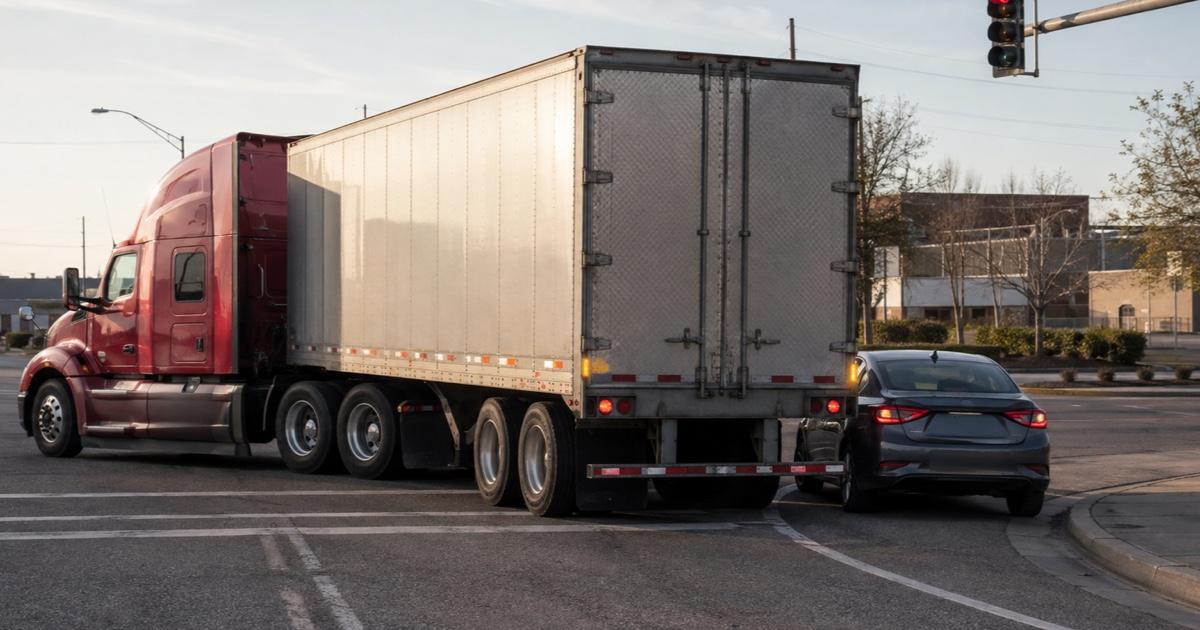
A tractor-trailer that swings wide to make a right turn — and crushes a car that was lawfully in the right lane or against the curb — is not excused by its size. Oklahoma law tells every driver, including a professional in an 80,000-pound rig, where a right turn is supposed to begin and end: as close as practicable to the right-hand curb. Federal licensing rules go further and treat correct turn positioning, including the management of "off-tracking," as a core commercial-driving skill. When a trucker instead sets up a turn from the middle lane, leaves an open lane of pavement beside the trailer, and closes it mid-turn on a car the driver never rechecked, the size of the truck explains how the crash happened — it does not decide who is legally responsible. This article walks through the Oklahoma statutes and federal regulations that govern a wide-turn or "squeeze play" collision, and how the trucking company's favorite defense plays out under comparative fault.
This article is general legal information, not legal advice about any specific crash. Wide-turn cases are fact-intensive, and the framework below is a starting point, not a prediction.
Why Trucks Swing Wide — and Why That Is Not a Legal Free Pass
A combination vehicle does not turn the way a car does. The trailer's rear wheels follow a shorter path than the tractor's front wheels — the phenomenon the trucking industry calls off-tracking. A driver has to give that turn room, but Oklahoma's current Commercial Driver's License Manual is specific about how. It instructs a driver who cannot turn from one lane to widen the turn as it is completed, keep the rear of the vehicle close to the curb so others cannot pass on the right, and avoid swinging left before starting the turn. The squeeze play is the crash those instructions are meant to prevent. FMCSA's public safety materials list wide turns alongside blind spots and long stopping distances as operating challenges of large trucks and buses, and the agency's Safe Driving Around CMVs materials warn car drivers, cyclists, and pedestrians that large vehicles make wide turns.
The "squeeze play" is what happens when that maneuver goes wrong: the tractor swings out, a gap opens along the curb or in the right lane, a car moves into or remains in that gap, and the trailer then sweeps back across it. The car is caught between the trailer and the curb — or forced into it.
The physics are real, and every trucking company will lean on them. But off-tracking is not a surprise to a commercial driver; it is a defined subject the driver was tested on. The legal question in a wide-turn case is not whether the truck needed extra room. It is whether the driver managed that need the way Oklahoma statute and federal regulation require — with position, signal, and continued attention to the lane being closed.
The Oklahoma Statutes That Govern a Turning Truck
Two provisions of the Oklahoma rules of the road do most of the work.
The first sets the position. Under 47 O.S. § 11-601(1), "[b]oth the approach for a right turn and a right turn shall be made as close as practicable to the right-hand curb or edge of the roadway." The statute speaks in terms of what is practicable, and a long combination vehicle may genuinely need more room than a sedan. But "practicable" is not "convenient," and the statute's structure matters: the closeness requirement applies to the approach as well as the turn. A driver who needs to occupy part of a second lane to complete a turn has to account for how the approach was set up and what was done to keep other vehicles out of the gap. Section 11-601(3) separately provides that local authorities may mark a different course for turns at particular intersections — and where such markings exist, drivers must follow them.
The second sets the conditions. Under 47 O.S. § 11-604(A), no person may turn a vehicle at an intersection, road, or driveway "unless the vehicle is in proper position upon the roadway as required in Section 11-601," nor move right or left upon a roadway "unless and until such movement can be made with reasonable safety," nor turn without an appropriate signal if any other traffic may be affected. Subsection B requires that turn signal to run continuously for at least the last one hundred (100) feet before turning. The statute chains the two sections together: a turn begun from an improper position is a problem under § 11-604 before the trailer ever moves.
Neither statute contains a large-vehicle exception. A jury can certainly consider a truck's turning geometry in deciding what was practicable and reasonably safe — but the statutes put the duty to manage that geometry on the driver making the turn, not on the car beside it.
Federal Rules Make Turn Positioning a Tested Professional Skill
The commercial licensing rules remove any suggestion that off-tracking is beyond a truck driver's expected competence.
On the knowledge side, 49 C.F.R. § 383.111(a)(4)(iv) requires every CMV operator to know the proper procedures for "[t]urning the vehicle, e.g., basic rules, off tracking, right/left turns and right curves." The same section requires knowledge of signaling intent when changing direction in traffic (subsection (a)(8)) and of space management, including "[s]pace to the sides" (subsection (a)(10)).
On the skills side, the regulation is strikingly specific to this exact crash. 49 C.F.R. § 383.113(b)(5) places among the basic control skills the "[a]bility to position the motor vehicle to negotiate safely and then make left and right turns." Section 383.113(c)(5) likewise identifies as an on-road skill the "[a]bility to position the motor vehicle correctly before and during a turn to prevent other vehicles from passing on the wrong side, as well as to prevent problems caused by off-tracking." Part 383 contains limited testing waivers and recognizes certain Canadian and Mexican commercial licenses, so those standards should not be mistaken for proof that every individual driver took the same United States road test.
That language matters in litigation. The regulation expressly treats positioning a vehicle to prevent passing on the wrong side as an on-road driving skill, making the risk of a squeeze play difficult to characterize as unforeseeable. Our blind-spot and No-Zone guide covers the companion rules — mirrors and visual search — that govern what the driver should have seen along the trailer's side before the trailer closed the lane.
When a Statute Violation Becomes the Negligence Case
Oklahoma treats the violation of certain safety statutes and regulations as negligence in itself. In Howard v. Zimmer, Inc., 2013 OK 17, the Oklahoma Supreme Court — answering a question certified by the Tenth Circuit, in the plaintiffs' favor — reaffirmed the elements: the injury must be caused by the violation, must be of the type the provision was designed to prevent, and the injured person must be within the protected class. Rules of the road exist to protect other people on the roadway, and a car occupying the lane a turning trailer swept across sits squarely in that class.
One honest caveat belongs here. Sections 11-601 and 11-604 are phrased with built-in flexibility — "as close as practicable," "with reasonable safety." Oklahoma courts do not automatically convert every rule-of-the-road statute into a negligence per se instruction, and a statute that leaves room for judgment may end up functioning as powerful evidence of the standard of care rather than as an automatic rule of liability. Which way a particular court treats these turning statutes is a question for counsel in a particular case. The Oklahoma Supreme Court has refused a negligence per se instruction for a traffic statute framed in flexible terms because it did not impose a positive, objective standard (Wade v. Reimer, 1961 OK 44). And even when negligence per se applies, Howard makes clear that a violation does not establish causation; Busby v. Quail Creek Golf & Country Club, 1994 OK 63, also recognizes that a violation may be excused when reasonable diligence could not achieve compliance. Either way, the statutes frame the trial: they tell the jury where Oklahoma expects a right turn to begin, and they strip the "trucks just have to swing wide" argument of any legal privilege.
The "You Tried to Squeeze By" Defense
Expect the carrier to turn the maneuver around. FMCSA's tips for passenger-vehicle drivers tell motorists to allow trucks extra space and time, wait for a large vehicle to finish turning, and expect that a right-turning truck may initially move left to create enough room. The defense will argue that a driver who pulled alongside a signaling, turning truck — or lingered next to it at an intersection — created the trap. If the truck's signal had been running and the gap opened only because the tractor swung out to set up the turn, the argument will be that the gap was never a lane of travel at all. That advice is relevant evidence about what a motorist may have perceived; it is not a statute and does not decide fault.
Oklahoma answers with percentages, not absolutes. Under 23 O.S. § 13, contributory negligence does not bar recovery unless the injured person's share of fault is greater than the combined fault of everyone else who caused the wreck, and under 23 O.S. § 14, a recovery is reduced in proportion to that share. Our article on Oklahoma's 51 percent bar explains how the arithmetic works in practice.
The facts that move those percentages are concrete: whether the truck's signal was actually on and for how long, where the turn was set up, whether the trailer ever cleared the right lane, how long the car had been beside the trailer, and whether the car entered the gap before or after the truck committed to the turn. A wide-turn case is rarely all-or-nothing — it is a fight over sequence, timing, and position, which is why the evidence below matters so much.
Depending on the facts, responsibility may also reach past the driver — to the motor carrier and others in the chain. Our guides to who can be sued after an Oklahoma truck wreck and intersection accidents in Oklahoma cover the surrounding theories.
The Evidence That Reconstructs the Turn
Wide-turn cases are built from physical and electronic evidence, and much of it sits in the carrier's hands with short retention clocks.
The sweep of the trailer usually leaves its own record: gouge and scrub marks at the curb radius, the location and angle of impact damage along the car and trailer, and the final rest positions all speak to where the turn began and what path the trailer actually traveled. Intersection cameras — traffic, business, doorbell — are often the single best source and are frequently overwritten within days. Forward-facing dashcams, where the tractor is equipped, may capture the setup and signal timing; engine control data may preserve speed and brake application through the turn. Our ECM black box guide explains what those systems do and do not record, and our first 72 hours after a semi-truck crash guide explains why a preservation letter goes out immediately in a serious case.
The driver's file matters too. Federal licensing standards treat turn positioning and off-tracking as tested skills. Separately, the carrier's training materials and safety policies may address urban turns — button-hook versus jug-handle technique, signal timing, and mirror checks through the turn — and can show what the company expected from its driver.
Frequently Asked Questions
The truck had its turn signal on. Doesn't that make the crash my fault?
No — a signal is one fact, not a verdict. The signal requirement in 47 O.S. § 11-604 protects other drivers, but a signal does not license a turn begun from an improper position, and it does not answer whether the movement could be made with reasonable safety when the trailer swept the lane. Whether you saw or should have seen the signal, and when the truck actually committed to the turn, are comparative-fault questions a jury weighs in percentages.
Is a truck allowed to start a right turn from the middle lane?
Oklahoma's default rule requires the approach and the turn to be made as close as practicable to the right-hand curb. What is practicable depends on the roadway, the vehicle, and the turn. Taking part of a second lane does not end the fault analysis: FMCSA itself recognizes that a right-turning truck may initially move left, while Oklahoma's CDL manual instructs drivers to keep the rear close to the curb and avoid swinging left at the start. The questions are why the extra lane was needed, how the driver protected traffic in the lane being closed, and whether the movement satisfied § 11-604's reasonable-safety and signal requirements. Local markings under § 11-601(3) can also change the required course at a specific intersection.
What if I was partly at fault for being beside the truck?
Partial fault reduces a recovery in Oklahoma; it does not eliminate it unless your share exceeds the combined fault of everyone else who caused the wreck. In a squeeze-play collision the percentages turn on sequence — who created the gap, who closed it, and what each driver could have seen and done in the seconds before impact.
What evidence should be preserved after a wide-turn crash?
Move quickly on anything overwritten: intersection and business camera footage, the tractor's dashcam and electronic data, and the scene itself — curb marks, debris fields, and vehicle damage should be photographed before repairs. The driver's qualification and training records and the carrier's turn-technique policies come later through discovery, but a preservation letter should demand all of it at the start.
Talk to an Oklahoma Truck Accident Lawyer
If a turning tractor-trailer trapped your car against a curb or swept across your lane anywhere in Oklahoma, the evidence that reconstructs the turn — camera footage, electronic data, and the marks at the intersection itself — can begin disappearing within days. Our Oklahoma trucking accident lawyers handle wide-turn and intersection cases across the state. Contact us for a free consultation. This article is general information, not legal advice, and does not create an attorney-client relationship.
Caught in a Truck's "Squeeze Play"?
Where the turn was set up, when the signal started, and what path the trailer actually swept can often be reconstructed — but the cameras, electronic data, and scene evidence that show them fade fast. We move quickly to identify and preserve what shows how the turn really happened.
Talk to a Trucking Accident Lawyer