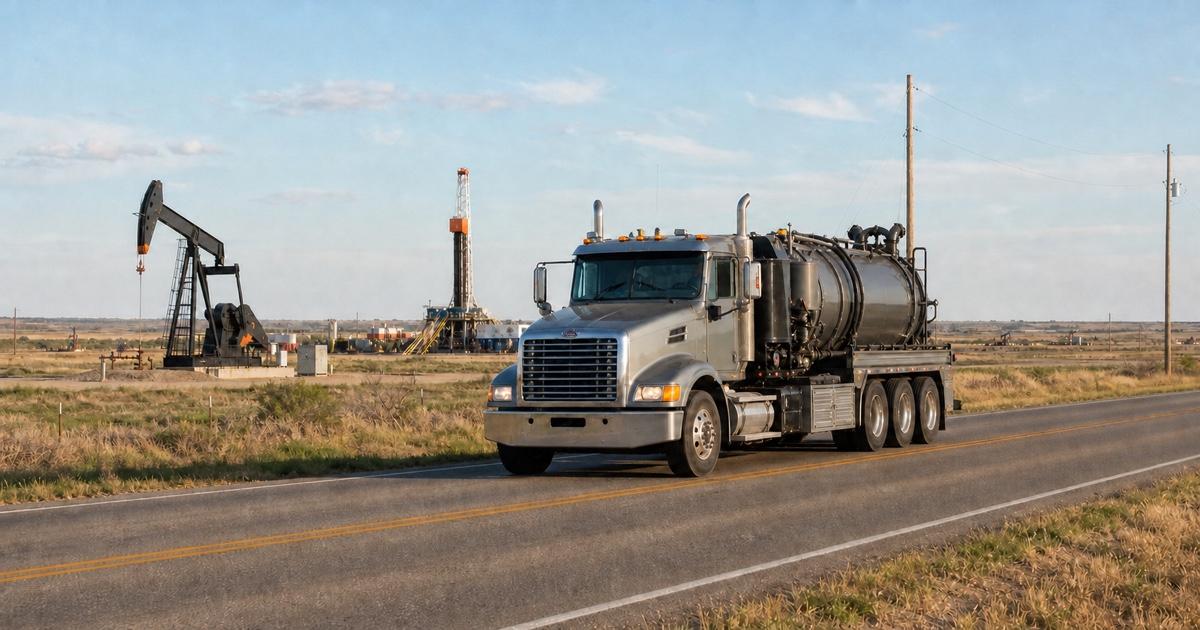

Key Takeaways
- Oilfield Trucking Has Different Fatigue Rules: Under 49 C.F.R. § 395.1(d), qualifying oilfield drivers may restart the 8-day on-duty period after 24 successive hours off. A narrower group of specially trained operators driving specially constructed well-servicing equipment may record well-site waiting time as off duty.
- Frac-Sand Eligibility Requires a Fact-Specific Review: FMCSA's 2012 guidance excludes supply trucks hauling sand or water from the waiting-time exception. But the agency's current frac-sand FAQ says operators may qualify if the truck is specially constructed for well-site use and the driver needs extensive training to operate its complex equipment.
- An Exception Is Not Immunity: If the truck or driver did not fit the exception, the hours recorded as off-duty waiting were on-duty hours and may put the driver over the ordinary limits. Separate federal law also forbids driving when fatigue makes continued operation unsafe, whatever the logbook says.
Oilfield trucks in Oklahoma do operate under different fatigue rules than ordinary semis. The differences are narrower than the label "oilfield" suggests. Federal law gives qualifying drivers a 24-hour restart of the 8-day on-duty period, and it lets a smaller class of specially trained operators driving specially constructed well-servicing equipment treat waiting time at the well site as off duty. Both exceptions appear in 49 C.F.R. § 395.1(d).
After a crash involving a water hauler, frac-sand truck, crude tanker, or rig mover, the key question is not simply whether the driver was tired. It is whether the truck, driver, and operation actually fit the exception used in the logs.
This article is general legal information, not legal advice about any specific crash. Whether an oilfield exception applied — and whether it was used lawfully — depends on facts that need individual review.
Why Oilfield Trucking Is Its Own Safety Problem
Oil and gas work is a driving-intensive business. Wells sit at the end of rural two-lane roads, and each stage of drilling and completion requires equipment, pipe, water, and sand to move to and from the pad. A federal study of oil and gas extraction deaths from 2003 through 2013 found that transportation incidents accounted for 479 of 1,189 worker deaths, more than any other event category. Most of those transportation deaths involved light trucks rather than the heavy commercial vehicles discussed here. The narrower point remains: driving between yards, pads, and disposal sites is a central hazard in oilfield work, and heavy service trucks share those rural roads with Oklahoma families.
Federal regulators have treated oilfield trucking differently for more than sixty years. The Interstate Commerce Commission rejected an oilfield exception in 1939, then changed course in 1962. It approved the 24-hour restart in March and, about five months later, granted the waiting-time exception without explanation. Those provisions were later carried into today's § 395.1(d). Understanding what they do — and what they do not do — is the starting point for a serious oilfield crash investigation.
The Baseline: What Normal Hours-of-Service Rules Require
For ordinary property-carrying truckers, 49 C.F.R. § 395.3 generally requires 10 consecutive hours off before driving, limits driving to 11 hours inside a 14-hour window, requires a 30-minute interruption before driving after more than 8 cumulative hours without one, and caps on-duty time at 60 hours in 7 days or 70 hours in 8 days. A driver may take a voluntary 34-hour restart rather than wait for older hours to roll off. Our guide to hours-of-service violations explains the ordinary rules in more detail.
Oilfield operations have two standing exceptions to that framework. Each has a different scope.
Exception One: The 24-Hour Restart
Under § 395.1(d)(1), drivers of commercial motor vehicles "used exclusively in the transportation of oilfield equipment, including the stringing and picking up of pipe used in pipelines, and servicing of the field operations of the natural gas and oil industry" may restart their 8-day on-duty period with 24 or more successive hours off — rather than the ordinary 34-hour restart.
The Federal Motor Carrier Safety Administration's guidance at 77 Fed. Reg. 33098 reads this exception broadly. It covers trucks used in direct support of well-site operations, including vehicles carrying equipment, water, waste, or product and vehicles moving between sites. FMCSA later confirmed that sand-delivery trucks can fall within this restart rule. The vehicles need not be specially built, and the drivers need no training beyond what is required to operate the truck. But the word exclusively matters: a truck used for general freight as well as oilfield service may not qualify.
What does that mean in practice? A qualifying driver who reaches 70 on-duty hours in 8 days can begin a new 8-day period after 24 hours off. That schedule can comply with § 395.1(d)(1). It does not authorize fatigued driving. A separate rule, 49 C.F.R. § 392.3, forbids a driver from operating — and a carrier from requiring or permitting operation — when fatigue impairs the driver's ability or alertness enough to make driving unsafe.
Exception Two: "Waiting Time" at the Well Site
Section 395.1(d)(2) is much narrower. For "specially trained drivers of commercial motor vehicles that are specially constructed to service oil wells," time spent waiting at a natural gas or oil well site does not count as on-duty time. The driver must record that time as off duty and identify it with an annotation or a separate "waiting time" line. The waiting period also does not count toward the 14-hour driving window.
An ordinary trucker who comes on duty at 6 a.m. generally cannot drive after 8 p.m.; waiting at a shipper remains on-duty time. A qualifying well-servicing operator may exclude hours spent waiting at the pad and drive after the ordinary window would have closed. FMCSA acknowledged the tension in 78 Fed. Reg. 48817, observing that the safety rationale for the 14-hour window applies with particular force to drivers using the waiting-time exception. A driver using § 395.1(d)(2) also cannot use the 150-air-mile short-haul exception in § 395.1(e)(1).
FMCSA's 2012 guidance lists equipment that may qualify: heavy-coil vehicles, missile trailers, nitrogen pumps, wire-line trucks, sand storage trailers, cement pumps, frac pumps, blenders, hydration pumps, and separators. The list is illustrative. The governing test is whether the vehicle is specially constructed for well-site use and whether its operator needs extensive training to run the complex equipment beyond merely driving the vehicle.
The same guidance says supply trucks carrying materials such as sand and water do not qualify merely because the vehicle has some modifications or the driver has limited extra training. But FMCSA later changed the answer for some frac-sand operations. In a FAQ last updated January 3, 2025, the agency said a vehicle of any type may qualify if it meets the two-part test, and specifically told frac-sand operators to assess their equipment and driver training. FMCSA said it would amend the older guidance; the public guidance still has not been reconciled.
That makes the logs only the beginning. When a driver records hours at the pad as off-duty waiting time, the investigation must determine whether that particular truck and that driver's training met the two-part test. If they did not, the waiting hours were on-duty hours, and the driver's actual totals may exceed the ordinary limits. The older sand-and-water exclusion remains a serious obstacle for a water hauler. A frac-sand truck requires a fact-specific review, not a categorical answer.
Trucks That Never Leave Oklahoma
The federal rules directly govern interstate commerce. An oilfield truck that stays within Oklahoma may still be covered because state law directs the Department of Public Safety to adopt driving-hour rules consistent with the federal framework, 47 O.S. § 230.15(D), and DPS has adopted Parts 392 and 395 by reference at OAC 595:35-1-4.
The state safety rules have a coverage threshold. For intrastate commerce, they generally apply to vehicles with a qualifying rating or actual weight of 10,001 pounds or more, passenger vehicles within the rule's stated categories, and vehicles carrying placardable quantities of hazardous materials. Oklahoma also permits up to 12 hours of driving for a vehicle operating solely in intrastate commerce that is not transporting hazardous materials as federal law defines them, requires at least 8 consecutive hours off before driving, and bars DPS from imposing the federal 30-minute break rule on solely intrastate drivers. Those differences are substantial. The vehicle, cargo, route, and crash date all matter when deciding which rule applied.
What This Means After a Crash
Because oilfield carriers may use special exceptions, the paper trail differs from an ordinary trucking case. It also has a short shelf life: 49 C.F.R. § 395.8(k)(1) requires a motor carrier to keep records of duty status and supporting documents for only six months. Our guide to preserving trucking evidence explains the preservation letter; an oilfield case may require:
- Records of duty status with waiting-time annotations. Section 395.1(d)(2) requires the driver to identify waiting time in the log. Large blocks of unexplained off-duty time at a well site — especially for equipment or training that did not fit the rule — deserve close review.
- Well-site gate logs, sign-in sheets, and run tickets. Not every pad keeps these records, and those that exist are often held by the operator or a service company rather than the carrier. Where available, they can test whether claimed waiting time matches the driver's movements and work.
- Facts showing the exception fit. Was the truck used exclusively in oilfield service? Was the vehicle specially constructed? Did the driver receive extensive training to operate complex equipment? Those facts must be developed rather than assumed from the carrier's log labels.
- Dispatch and payroll records. Pay structures that reward loads-per-day, and dispatch patterns that assume drivers will use the 24-hour restart week after week, speak to what the company knew about the schedules it was demanding.
An exception changes the hours calculation. It does not override § 392.3's rule against unsafe fatigued driving. Because oilfield hauling often involves layered contractor relationships — the driver, carrier, service company, and well operator — identifying every company that may be responsible can be as important as reconstructing the hours.
Hit by an Oilfield Truck in Oklahoma?
Oilfield crash cases may turn on records that ordinary wrecks do not involve — waiting-time logs, dispatch records, run tickets, and proof about the truck and driver training. Our firm handles truck driver fatigue cases and oil field injury claims across Oklahoma. The carrier's federal log-retention period can be only six months, so early preservation matters.
Frequently Asked Questions
Do oilfield truck drivers have to follow the same hours-of-service rules as other truckers?
Mostly, yes. The driving-hour caps, weekly on-duty limits, drug and alcohol testing, and equipment rules still apply. Section 395.1(d) allows a 24-hour restart of the 8-day on-duty period and, for a narrower class of trained operators and specialized equipment, different treatment of well-site waiting time. Section 392.3 still prohibits unsafe fatigued driving.
What is the oilfield "waiting time" exception?
Under § 395.1(d)(2), qualifying drivers may log time spent waiting at a natural gas or oil well site as off duty, and that waiting does not count toward the 14-hour driving window. The log must identify the waiting periods. The exception applies only when the vehicle is specially constructed for well-site use and the driver needs extensive training to operate its complex equipment.
Does a water hauler or sand hauler qualify for the waiting-time exception?
Not automatically. FMCSA's 2012 guidance says supply trucks carrying sand or water do not qualify based on modest vehicle changes and limited extra training. Its current FAQ says a frac-sand truck may qualify if the vehicle is specially constructed for well-site use and the operator needs extensive training to run complex equipment. That makes frac-sand eligibility fact-specific. A water hauler still faces the older express exclusion. Either may use the 24-hour restart if the truck is used exclusively in qualifying oilfield service.
Do these exceptions apply to trucks that never leave Oklahoma?
Oklahoma applies the federal safety framework to covered intrastate carriers through 47 O.S. § 230.15 and DPS rules. The current state rule generally reaches intrastate vehicles at 10,001 pounds or more, along with listed passenger vehicles and placardable-hazmat vehicles. Oklahoma also has intrastate variances, including a 12-hour driving limit for qualifying non-hazardous-material runs and no federal 30-minute break requirement. The vehicle, cargo, route, and crash date determine which rules govern.
Talk to a Lawyer Who Knows Where to Look
Oilfield truck cases reward early, specific investigation: the logs, well-site records that actually exist, equipment evidence, training materials, and the schedule the company ran. If you or a loved one was hurt in a crash with an oilfield truck, our guide to the first 72 hours after a semi-truck crash explains the immediate steps. Our article on sleep apnea and truck driver fatigue covers the medical-certification side of fatigue. There is no fee to ask, and no obligation — contact Addison Law Firm for a free consultation.