
Key Takeaways
- The Duty Belongs to the Driver Who Moves: Under 47 O.S. § 11-309(2), a vehicle may not be moved from its lane "until the driver has first ascertained that the movement can be made with safety," with a signal for at least the last 100 feet. 47 O.S. § 11-303 imposes the same "first see that such movement can be made with safety" duty on passing. Neither statute contains a blind-spot exception.
- Seeing Is a Professional Requirement: Federal law requires trucks to carry mirrors showing the highway "along both sides of the vehicle" (49 C.F.R. § 393.80), and it makes "visual search" — seeing ahead, to the sides, and to the rear, including proper mirror use — required CDL knowledge and a tested on-road skill (49 C.F.R. § 383.111(a)(7); § 383.113(c)).
- Your Own Position Matters Too: FMCSA tells motorists to stay out of a truck's "No-Zones," and the defense will use that advice. Under Oklahoma's comparative negligence statute, 23 O.S. § 13, being partly at fault reduces a recovery but does not bar it unless your share of fault is greater than the combined fault of everyone else who caused the wreck.
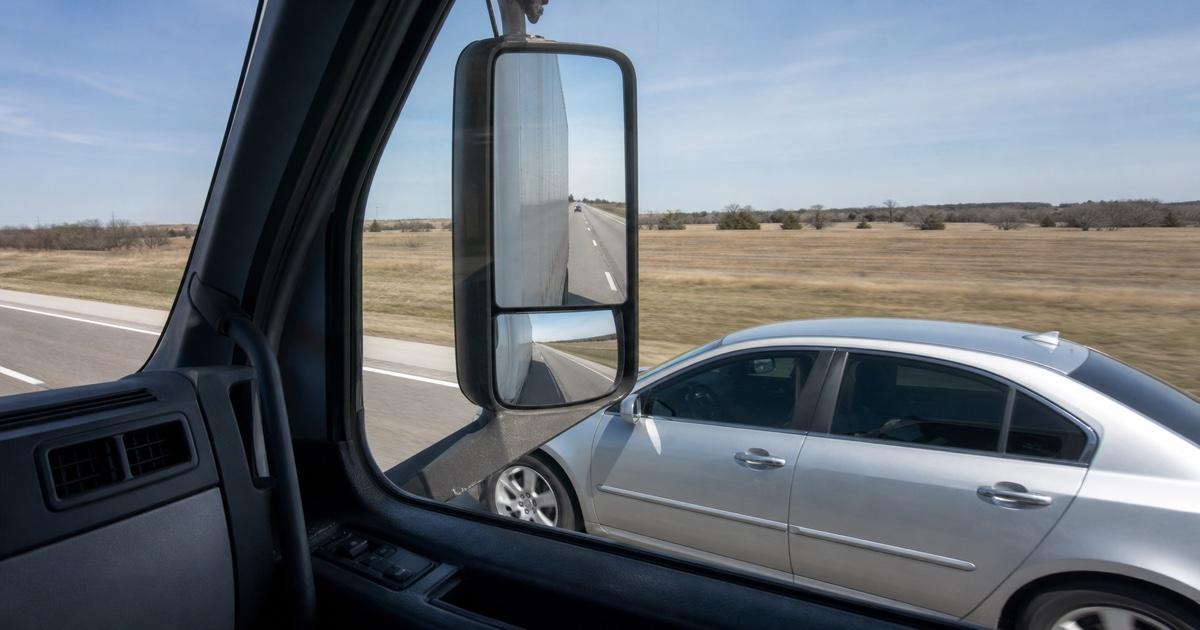
A truck driver's blind spot is not, by itself, a legal defense in Oklahoma. When a tractor-trailer changes lanes or merges into a car the driver says he never saw, Oklahoma law does not ask whether the trucker saw the car. It asks whether the trucker complied with a duty that exists precisely because trucks are hard to see out of: the statutory duty to first ascertain that a lane change can be made with safety before making it. Federal trucking rules push in the same direction — they require mirrors that show both sides of the rig and make "visual search" a required professional skill for every commercial driver. This article explains what the "No-Zone" actually is, which Oklahoma statutes and federal regulations govern a blind-spot lane-change wreck, and how the trucking company's favorite argument — that you were the one hiding in the blind spot — plays out under Oklahoma comparative fault.
This article is general legal information, not legal advice about any specific crash. Blind-spot cases are fact-intensive, and the framework below is a starting point, not a prediction.
What the "No-Zone" Actually Is
FMCSA safety materials call the large blind spots around the front, back, and sides of a truck the "No Zones." In its guidance, Tips for Driving Safely Around Large Trucks or Buses, the agency's rule of thumb for motorists is blunt: "If you can't see the driver in the truck's side mirror, assume that the driver can't see you." FMCSA's current passenger-vehicle guidance tells motorists not to linger in a blind spot, to make sure the truck or bus is visible in the rearview mirror before pulling in front of it, and to give large vehicles extra room.
That guidance is written for the people driving next to the truck, and it matters in litigation for exactly that reason — it is the seed of the defense argument discussed below. But the guidance describes a driving reality, not a legal privilege. Nothing in the No-Zone concept relieves a commercial driver of the duties that Oklahoma statute and federal regulation place on the person moving an 80,000-pound vehicle across a lane line. Rear No-Zone crashes can raise a different danger; our underride accident guide explains what happens when a smaller vehicle travels beneath a trailer.
Oklahoma Law Puts the Burden on the Driver Who Moves
Two Oklahoma statutes do most of the work in a blind-spot lane-change case.
The first is the lane statute. Under 47 O.S. § 11-309(2), on any roadway divided into clearly marked lanes, a vehicle "shall not be moved from the lane until the driver has first ascertained that the movement can be made with safety and then given a signal, not less than the last one hundred (100) feet traveled by the vehicle, of his or her intention to change lanes." The sequence in the statute is deliberate: ascertain first, signal second, move third. A driver who changes lanes into a car that was not seen still has to account for what happened before the move. That is a fact question, not an automatic answer; Oklahoma does not treat the fact of a collision as proof that a rule-of-the-road statute was broken. But the statute contains no blind-spot exception. It says "ascertained." It does not say "ascertained, unless the vehicle was in a blind spot."
The second is the passing statute. 47 O.S. § 11-303 requires an overtaking driver to pass "at a safe distance" and not return to the right side of the roadway "until safely clear of the overtaken vehicle." It separately requires every driver who intends to pass another vehicle, "which requires moving his vehicle from one lane of traffic to another," to "first see that such movement can be made with safety" and to signal before pulling out. A truck driver who swings back into the right lane and clips the car just passed, or who begins a pass without clearing the adjacent lane, is measured against that language.
Both statutes are traffic laws enacted for the safety of people on the road, which is what makes them more than context. Violating them can be the foundation of the negligence case itself, as discussed below.
Federal Rules Make Seeing a Professional Skill
The trucking side of the case is governed by a second rulebook. Under 49 C.F.R. § 393.80(a), every bus, truck, and truck tractor must be equipped with two rear-vision mirrors, one at each side, "so located as to reflect to the driver a view of the highway to the rear, along both sides of the vehicle." Mirror equipment and placement are regulated, and 49 C.F.R. § 392.7(a) bars a driver from moving the truck unless satisfied the rear-vision mirrors are in good working order. Adjustment works differently: no federal rule dictates how a mirror must be set, but "proper mirror adjustments" is a subject every CDL holder is required to know under 49 C.F.R. § 383.111(a)(3)(i). A missing, damaged, or badly adjusted mirror is a fact worth establishing early.
The commercial licensing rules go further, because they treat the act of seeing as a skill the driver must know and demonstrate. 49 C.F.R. § 383.111(a)(7) makes "visual search" required CDL knowledge — "seeing ahead and to the sides," "use of mirrors," and "seeing to the rear." The same section requires knowledge of proper signaling when changing direction in traffic (subsection (a)(8)) and managing the space around the vehicle, including "space to the sides" (subsection (a)(10)). On the skills side, 49 C.F.R. § 383.113(c) requires every CDL applicant to demonstrate "proper visual search methods," appropriate signaling, and the ability "to choose a safe gap for changing lanes" — on the road, in the tested vehicle class.
The practical meaning for a lane-change wreck: a commercial driver cannot credibly describe the blind spot as a surprise. Managing it — through mirror adjustment, signaling, and gap selection — is part of the professional standard the license certifies.
When a Statute or Regulation Violation Becomes the Case
Oklahoma treats certain safety-law violations as negligence in themselves. In Howard v. Zimmer, Inc., 2013 OK 17, the Oklahoma Supreme Court answered a question certified to it by the Tenth Circuit and held that a violation of a federal regulation — not just a state statute — may support a negligence per se claim under Oklahoma law; the court answered the certified question in the plaintiffs' favor. The opinion restates the familiar elements: the claimed injury must be caused by the violation, the injury must be of the type the provision was intended to prevent, and the injured person must be within the class the provision was meant to protect.
Whether a particular statute or regulation supports a negligence per se instruction in a particular blind-spot case is a question for the lawyers and ultimately the court — causation and the protected-class elements still have to be proven. The lane-change and passing statutes exist to protect other people on the roadway from unsafe movements, and Howard keeps federal safety regulations on the table as well. That is not a blank check. Oklahoma federal courts examine federal regulations one at a time and have refused to build negligence per se on rules too general to set a concrete standard. The CDL knowledge and skills rules are most useful as evidence of what a licensed commercial driver is supposed to know, not as stand-alone negligence per se violations.
"You Were in My Blind Spot" — the Comparative Fault Fight
Expect the defense to turn the No-Zone around. FMCSA's own motorist guidance says to stay out of blind spots, not to linger while passing, and not to cut in close in front of a truck. If the evidence shows a motorist camped beside the trailer for a mile or darted across the truck's hood, the carrier will argue the motorist ignored that advice and shares the fault.
Oklahoma resolves that argument with percentages, not absolutes. Under 23 O.S. § 13, contributory negligence does not bar recovery unless the injured person's negligence is greater than the combined negligence of everyone who caused the harm, and under 23 O.S. § 14, any recovery is reduced in proportion to the injured person's share. Our article on Oklahoma's 51 percent bar walks through how those percentages operate in practice. The blind-spot fight is therefore rarely all-or-nothing: the question is how a jury weighs a professional driver's statutory duty to ascertain before moving against a motorist's position on the road in the seconds before the wreck.
Depending on the facts, the responsible parties may also extend beyond the driver — to the carrier that hired and trained the driver, or others in the chain. Our guides to who can be sued after an Oklahoma truck wreck and negligent hiring in trucking cases cover those theories.
The Evidence That Shows What the Driver Could Have Seen
Blind-spot cases are built with reconstruction, and the sources are time-sensitive. The tractor's mirror configuration should be documented before the rig is repaired or returned to service. Forward-facing and driver-facing dashcams, where equipped, may show the mirror checks that did or did not happen. Depending on the module and the event, engine control data may preserve road speed, throttle, and brake application around the lane change; steering input generally is not on an engine ECM, and where it exists it comes from a separate collision-avoidance or telematics unit. Our ECM black box guide explains what those systems do and do not capture.
The driver's CDL certifies testing on visual search and space management under 49 C.F.R. § 383.111(a)(7) and (a)(10). If the driver first obtained or upgraded a Class A or B CDL on or after February 7, 2022, entry-level training records cover the same subjects, although the training provider generally keeps those records for only three years under 49 C.F.R. § 380.725(c). The carrier's driver qualification file is narrower — application, driving records, road test, annual review, and medical qualification — but it is still worth obtaining. Carrier policies on lane changes and mirror checks may also show the company's internal standard.
The retention clocks are short. A driver vehicle inspection report, if one was required, is kept for three months under 49 C.F.R. § 396.11(a)(4), while records of duty status and electronic logging device data are generally kept for six months under 49 C.F.R. §§ 395.8(k)(1) and 395.22(i)(1). Much of this evidence sits in the carrier's hands, which is why the first 72 hours after a semi-truck crash matter and why a preservation letter goes out early in a serious case.
Where the wreck happened matters too. Lane-change and merge collisions concentrate where commercial traffic weaves — our truck crash corridor guide profiles the I-35, I-40, and I-44 routes that carry most of Oklahoma's through-truck traffic, and our I-35 truck accident page covers the corridor where these merges are a daily event.
Hit by a Truck That "Never Saw You"?
The mirror configuration, inspection reports, electronic data, and — if the tractor was so equipped — camera footage that show what the driver could have seen sit with the trucking company. Some of it the carrier only has to keep for a matter of months. We move quickly to identify and preserve it.
Talk to a Trucking Accident LawyerFrequently Asked Questions
If I was in the truck's blind spot, is the wreck automatically my fault?
No. Oklahoma has no rule that assigns fault based on where your car sat relative to a truck's mirrors. The trucker's duty under 47 O.S. § 11-309(2) — to first ascertain that a lane change can be made safely before making it — applies regardless of where you were. Your position and driving are weighed as part of comparative fault under 23 O.S. § 13, which reduces a recovery in proportion to your share of fault and bars it only if your share is greater than the combined fault of everyone else who caused the wreck.
Does "I checked my mirrors and didn't see the car" excuse the lane change?
A mirror check is evidence of care, not automatically a complete answer. The statutory duty runs before the vehicle moves — the driver must "first ascertain[] that the movement can be made with safety" — and it is not satisfied merely by describing a glance after the fact. Federal licensing standards treat visual search as broader than a single mirror check: 49 C.F.R. § 383.113(c) requires a CDL applicant to demonstrate "proper visual search methods," the ability to "signal appropriately when changing direction in traffic," and the ability "to choose a safe gap for changing lanes." Whether a particular driver's mirror use met the standard is a fact question. Oklahoma law does not presume a violation from the collision alone, and the answer depends on reconstruction, available camera footage, and the driver's testimony.
What mirrors is a semi actually required to have?
Under 49 C.F.R. § 393.80(a), every bus, truck, and truck tractor must have two rear-vision mirrors, one on each side, positioned to reflect a view of the highway to the rear along both sides of the vehicle, meeting the federal motor vehicle safety standard in force when the vehicle was manufactured. Subsection (b) contains narrow exceptions for certain pre-1981 mirrors, vehicles whose drivers have a rear view through an interior mirror, and driveaway-towaway operations; none ordinarily describes a loaded tractor-trailer. The regulation sets a floor, not a ceiling — many carriers add convex spot mirrors, fender mirrors, or camera systems, and what the rig carried and how it was adjusted is a standard early question in a blind-spot case.
The truck had a "blind spot" warning sticker on the back. Does that change anything?
A sticker warns following drivers; it does not modify anyone's legal duties. The trucker's obligations under 47 O.S. §§ 11-303 and 11-309 and the federal equipment and skill rules exist independent of any decal. At most, the sticker becomes one more piece of context in the comparative fault analysis — alongside where each vehicle was, for how long, and what each driver did in the seconds before the collision.
Talk to an Oklahoma Truck Accident Lawyer
If a tractor-trailer merged or changed lanes into you anywhere in Oklahoma, the evidence that shows what the driver could have seen — mirrors, available cameras, electronic data, and driver records — can begin disappearing quickly, and some of it the carrier is required to keep for only a matter of months. Our Oklahoma trucking accident lawyers handle blind-spot and lane-change cases across the state. Contact us for a free consultation. This article is general information, not legal advice, and does not create an attorney-client relationship.