
Key Takeaways
- Many Box Trucks Need No Commercial Driver's License: For a single truck, the federal commercial driver's license weight line is a gross vehicle weight rating or actual weight of 26,001 pounds or more under 49 C.F.R. § 383.5, and that rule applies to trips inside Oklahoma too. Many moving and delivery box trucks are rated just under that line, though others the same length are rated above it, and a truck hauling hazardous materials in amounts that require placards needs a CDL at any weight.
- No CDL Does Not Mean No Rules: For interstate operations, the federal safety regulations define a commercial motor vehicle starting at 10,001 pounds under 49 C.F.R. § 390.5T. A box truck can be fully regulated freight equipment even though its driver never needed a CDL.
- Rented Trucks Raise a Federal Shield: Under the Graves Amendment, 49 U.S.C. § 30106, a company in the business of renting vehicles is generally not liable for a renter's crash merely because it owns the truck — but the statute by its own terms does not protect the rental company's own negligence or displace state insurance requirements.
- The Insurance Behind the Truck Varies Widely: A for-hire carrier hauling ordinary freight across state lines in a truck rated 10,001 pounds or more generally must maintain at least $750,000 in financial responsibility under 49 C.F.R. § 387.9. A consumer rental calls for a separate review of the rental agreement, any purchased protection plan, and the policies that may cover the renter or the crash. Identifying the coverage behind the truck is an early priority.
Box trucks include consumer moving rentals and commercial freight vehicles of different sizes. Their use and weight determine which licensing and safety rules need to be checked after a crash. Depending on who owned the truck and what it was doing, the crash may be governed by the full federal motor carrier safety framework, by Oklahoma's own rules, or by little more than the ordinary law of negligence and a rental agreement. This article explains where the legal lines sit — the CDL line, the 10,001-pound line, and the rental-company line — and why they decide who pays after a box truck crash.
This article is general legal information, not legal advice. Which rules governed a particular truck, driver, and trip — and what insurance actually stands behind a particular claim — are fact-specific questions that need review by an attorney on your actual facts.
What Counts as a Box Truck, and Why the Category Is Tricky
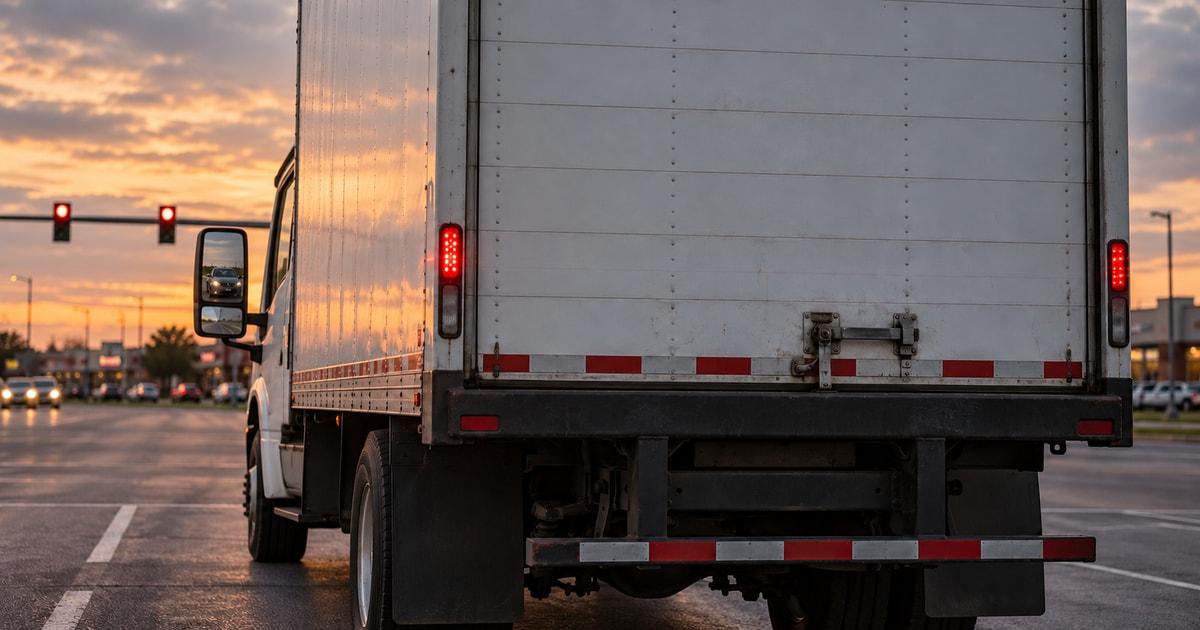
A box truck — also called a straight truck or cube van — is a single vehicle with a cargo box built onto the frame, rather than a tractor pulling a separate trailer. Local furniture and appliance deliveries, regional freight runs, rental moving trucks, and small-business work trucks all use the same basic machine, usually rated somewhere between a heavy pickup and a semi.
That range is exactly the problem. The law does not treat "box trucks" as one category. It draws lines by weight rating, by the kind of commerce the truck was engaged in, and by who owned and operated it. Two identical-looking trucks on the same Oklahoma City street can sit on opposite sides of every one of those lines. Sorting out which rules applied is not an academic exercise — it determines which safety duties the driver and company owed, which records exist, and how much insurance is available.
The CDL Line: 26,001 Pounds
Based on weight, federal law requires a commercial driver's license for a single vehicle when it has a gross vehicle weight rating or actual gross vehicle weight of 26,001 pounds or more, under the Group B definition in 49 C.F.R. § 383.5. That rule covers trips inside Oklahoma as well as interstate trips. Many box trucks are rated just under that line, the largest trucks in consumer rental fleets among them, while trucks of the same length are also built and rented with ratings above it. The practical result: the person maneuvering a tall, loaded truck rated at 25,999 pounds through an unfamiliar neighborhood may hold exactly the same license as the drivers around them, without the knowledge and skills testing a CDL requires. If the truck was in interstate commercial use, though, the driver generally still needed a federal medical certificate. And a truck hauling hazardous materials in amounts that require placards takes a CDL regardless of weight.
A no-CDL truck is not an unregulated truck, as the next section explains. But the licensing gap matters in a different way: it shapes the questions worth asking. Did the company put an untrained employee in the biggest vehicle he had ever driven? Did anyone check the driver's record before handing over the keys? Those are hiring, training, and entrustment questions, and they do not depend on whether a CDL was legally required. The same structural issue — rigs engineered to sit just under the CDL threshold — appears at the combination-vehicle line too, which we cover in our guide to hotshot trucking accidents.
The 10,001-Pound Line: When Federal Safety Rules Apply
For operations in interstate commerce, the Federal Motor Carrier Safety Regulations define a commercial motor vehicle to include any self-propelled vehicle used on a highway to transport property with a gross vehicle weight rating, gross combination weight rating, gross vehicle weight, or gross combination weight of 10,001 pounds or more, under 49 C.F.R. § 390.5T. Mid-size and large box trucks generally clear that threshold, though the smallest rental box trucks can be rated below it.
When the regulations apply, they bring the framework readers may associate with semis: driver qualification files, medical certification, vehicle inspection and maintenance duties, and hours-of-service rules, subject to their own exceptions. Our guide to truck driver medical certification explains how the non-CDL medical rules work, and our overview of who can be sued after an Oklahoma truck wreck maps the regulatory framework onto the defendant list.
Three caveats keep this honest. First, the federal definition turns on interstate commerce — and a trip that never leaves Oklahoma can still be one leg of interstate commerce. For a genuinely intrastate operation, check the applicable Oklahoma safety requirements separately; our dump truck liability guide discusses that inquiry. Second, the regulations contain exceptions and part-specific coverage rules, so whether a particular part applied to a particular truck needs verification, not assumption. One exception matters for moving trucks: the federal safety rules do not reach an individual's occasional transportation of personal property that is not for pay and not part of a business, the ordinary do-it-yourself move, under 49 C.F.R. § 390.3T(f)(3). Third, a regulatory violation is not automatic civil liability; the violation still has to be connected to the crash. What the 10,001-pound line often does is open the records: a regulated carrier is a carrier with files worth demanding, which is why preserving trucking evidence early matters in box-truck cases just as it does with semis.
Rented Box Trucks: The Graves Amendment and What It Does Not Do
Moving-truck crashes add a federal statute most people have never heard of. Under 49 U.S.C. § 30106, commonly called the Graves Amendment, a company engaged in the trade or business of renting or leasing motor vehicles is generally not liable under state law for harm arising out of the use of a rented vehicle by reason of being the vehicle's owner, so long as there is no negligence or criminal wrongdoing on the company's own part.
Read that carefully, because both halves matter. The shield eliminates claims built on ownership alone — the theory that the rental company must answer for the renter's bad driving simply because its name is on the title. It does not, by its own terms, protect the company from claims based on its own conduct. A claim that the company rented out a truck with bad brakes it failed to maintain, or entrusted a vehicle in circumstances that were themselves negligent, is a claim about the company's conduct, not its ownership; whether such a claim succeeds depends on the facts and on how Oklahoma law treats it, a framework we cover in our guide to negligent entrustment. The statute also expressly preserves state financial-responsibility and insurance requirements. How the Graves Amendment operates in ordinary rental-car crashes — and how the renter's own liability is unaffected by it — is covered in our rental car accident guide; the box-truck version of the problem is the same statute with higher stakes, because the vehicle is heavier and the renter may have little experience driving anything that size.
The practical consequence is that a rented-box-truck case usually centers on the renter and on whatever insurance actually applies. Review the rental agreement and every potentially applicable policy together, including any liability coverage the rental company provides for people driving its trucks. There may be the renter's own auto policy, whose application to a rented truck depends entirely on that policy's terms; any protection plan purchased with the rental, whose scope depends on the rental contract; and the injured person's own uninsured and underinsured motorist coverage, which we explain in our UM/UIM guide. None of those questions can be answered from the name painted on the truck.
The Insurance Gap: $750,000 or the State Minimum?
Here is the spread that shapes settlement reality. An interstate for-hire carrier of nonhazardous property operating vehicles rated 10,001 pounds or more generally must maintain at least $750,000 in financial responsibility under 49 C.F.R. § 387.9. At the other end, Oklahoma's minimum liability limits are $25,000 for injury to one person, $50,000 for injury to two or more people in one accident, and $25,000 for property damage, as defined in 47 O.S. § 7-103.
A box truck can sit anywhere along that spread. A for-hire interstate freight operation should have the federal-level coverage. For a carrier hauling its own goods or operating only inside Oklahoma, check the applicable insurance requirements and the policies actually issued rather than assuming the federal for-hire minimum applies. A consumer rental may be backed by far less — sometimes by nothing beyond a minimum-limits policy and a renter with no assets. For a serious injury, that difference matters more than almost anything else about the crash, and it is why identifying the truck's owner, operator, and operating authority quickly — before assumptions harden — is an early priority. It is also why box-truck victims should not accept an insurer's first framing of what coverage exists; layered policies, employer coverage, and the victim's own UM/UIM benefits all need independent checking.
Who Can Be Liable After a Box Truck Crash
The defendant map follows the truck's job. When the driver was working, Oklahoma's respondeat superior rule generally makes the employer answer for the driver's negligence on the job — the same structure that applies to semis, mapped out in who can be sued after an Oklahoma truck wreck. Claims aimed at the company's own hiring, training, and supervision require a separate analysis. In Jordan v. Cates, 1997 OK 9, the Oklahoma Supreme Court held that once an employer stipulates the employee was acting within the scope of employment, and punitive damages are available against the employer on that basis, a negligent hiring claim adds nothing. Negligent entrustment is different: in Fox v. Mize, 2018 OK 75, the court held that the employer's admission does not bar an entrustment claim, and it described that earlier holding as limited, for now, to its facts. The effect of an employer's admission on a particular hiring, training, or supervision claim needs claim-specific analysis. Delivery work adds its own wrinkle, because app platforms and contractor networks often classify drivers as independent contractors rather than employees; our guide to delivery driver accidents covers how those arrangements affect liability. A rented truck points at the renter and, within the limits described above, at the rental company's own conduct. And a borrowed box truck — a friend's business truck lent for a weekend move — raises the lending questions covered in our negligent entrustment guide.
Whatever the configuration, Oklahoma's general two-year deadline for personal-injury claims frames the outer timeline, with shorter practical windows for evidence; our statutes of limitations guide covers the deadlines and their exceptions. Telematics, dashcams, delivery-app data, and rental records are all perishable in the way trucking evidence always is, and none of them can be counted on to survive without a prompt preservation request.
Frequently Asked Questions
Do box truck drivers need a CDL in Oklahoma?
Often not, for the trucks most people picture. Under 49 C.F.R. § 383.5, a single truck requires a CDL when its gross vehicle weight rating or actual weight is 26,001 pounds or more, or when it hauls hazardous materials in amounts that require placards, and that rule applies to trips inside Oklahoma too. Many moving and delivery box trucks are rated just under 26,001 pounds, but others the same length are rated above it, so the truck's weight label and its actual loaded weight both need checking. A driver who needed no CDL may still have been subject to federal safety rules, including medical certification, if the truck was being used in interstate commerce.
Can I sue the rental company if a rented box truck hit me?
Not merely because it owned the truck. The Graves Amendment, 49 U.S.C. § 30106, generally bars state-law claims against a vehicle-rental business that rest on ownership alone. Claims based on the rental company's own negligence are a different matter under the statute's own terms, and the renter's personal liability is unaffected. What is realistically recoverable usually turns on the insurance picture, which takes investigation.
Is a box truck crash handled like a semi-truck case?
Sometimes — and finding out is step one. If a business was using a truck rated 10,001 pounds or more to move goods in interstate commerce, the truck was generally a regulated commercial motor vehicle whether the business owned, leased, or rented it, and whether it hauled for customers or for itself. That case can involve the same driver files, medical certification, inspection and maintenance records, and hours-of-service rules as a semi case. For a truck operating only inside Oklahoma, the applicable state safety requirements need a separate review. A rental truck used for an individual's own household move is different: the federal safety rules generally do not reach it, so the case turns more on ordinary negligence and the coverage behind the rental. Treating every box truck crash as "just a car accident" is the mistake that leaves records unrequested and coverage unfound.
What insurance applies after a box truck accident?
It depends on the operation. A for-hire carrier hauling ordinary freight across state lines in a truck rated 10,001 pounds or more generally must maintain at least $750,000 in financial responsibility under 49 C.F.R. § 387.9. For a carrier hauling its own goods or operating only inside Oklahoma, the applicable insurance requirements and the policies actually issued need a separate review. For a consumer rental, review the rental agreement, any purchased protection plan, and the policies that may cover the renter or the crash; the renter's own policy may add coverage, depending on its terms. Your own uninsured/underinsured motorist coverage can matter as much as the other side's policy, which is why both sides of the coverage picture need review.
Talk to an Oklahoma Truck Accident Lawyer
A box truck crash raises questions about the truck's operation, the records to seek, and the insurance that may apply. Read more about trucking accidents and preserving trucking evidence. Contact Addison Law Firm to discuss your situation. This article is general information, not legal advice, and does not create an attorney-client relationship.