
Key Takeaways
- A visibility defect can support a claim, but does not decide fault: The evidence must connect the truck's condition before impact to what an approaching driver could see and to the collision.
- The trailer's specifications matter: Federal conspicuity rules distinguish newer and older trailers, use width and weight-rating thresholds, and allow specified reflector alternatives to tape.
- Covered equipment must remain visible: Required lamps must work, and required lamps and reflective materials generally cannot be obscured by dirt, cargo, coverings, or added equipment.
- Preserve the truck before cleaning or repairs: Photographs, lamps, wiring, maintenance records, and original video may answer questions a repaired trailer cannot.
- Evidence deadlines and filing deadlines are different: Ordinary negligence suits generally have a two-year limit; an Oklahoma government claim can require notice within one year.
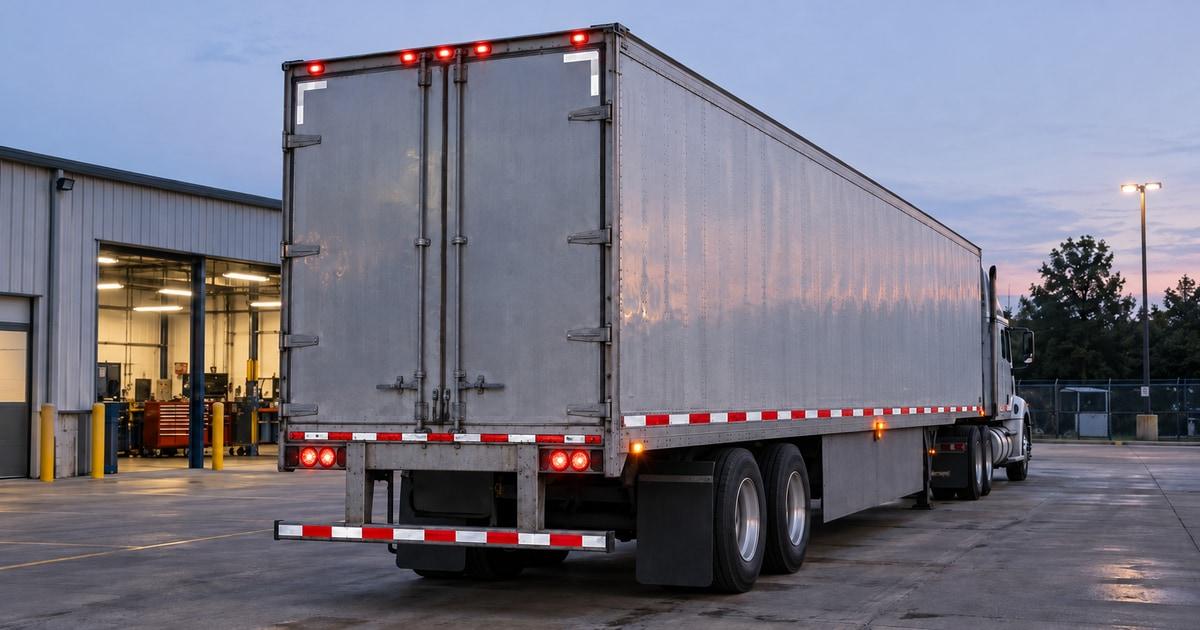
A truck with missing lights or inadequate reflective markings can contribute to an Oklahoma crash, and the driver, motor carrier, or another negligent party may be responsible. The question is not simply whether a trailer looks dark in a photograph. The investigation must establish which lighting and marking rules applied, whether the equipment was defective or obscured before impact, and whether that condition prevented another driver from recognizing the truck in time. A broken lamp after a collision does not, by itself, prove it was broken before the collision.
This is the visibility side of a trucking claim. It is different from whether a stopped driver should have placed emergency warning triangles, whether a trailer needed an underride guard, or whether a truck made an unsafe turn. Those issues can overlap, but each needs its own proof.
Lights, Reflectors, and Reflective Tape Do Different Jobs
A lamp produces light. A reflector or retroreflective marking returns light toward its source. Tail lamps, brake lamps, turn signals, side-marker lamps, and reflective markings are not interchangeable just because they help another driver notice a truck.
49 C.F.R. § 393.11 identifies required lighting and reflective equipment by vehicle type and incorporates applicable federal manufacturing standards. A tractor and its trailer therefore require separate inspection. A lit tractor cab does not establish that the trailer's rear lamps worked or that its side markings complied.
Start with the actual equipment: the tractor and trailer identification numbers, trailer manufacture date, overall width, gross vehicle weight rating, and configuration. The weight rating is not simply whatever the trailer happened to weigh on the crash date. Photographs of manufacturer labels can be as important as photographs of the damaged side panel.
Which rulebook applies depends on the vehicle and the trip. The federal equipment rules reach commercial motor vehicles in interstate commerce. Oklahoma has adopted those rules for some purely in-state hauls under OAC 595:35-1-4 and 595:35-1-5, with its own weight, passenger, and cargo thresholds. Oklahoma's separate lamp and reflector statutes also apply to vehicles on its highways generally. A small rig on an in-state trip may answer to a different set of rules than a tractor-trailer crossing state lines. Our guide to hotshot trucking accidents explains why the ratings and the nature of the trip deserve a closer look.
Which Trailers Need Conspicuity Markings?
For covered trailers manufactured on or after December 1, 1993, § 393.11(b) applies when overall width is at least 80 inches and gross vehicle weight rating exceeds 10,000 pounds. Pole trailers and trailers designed exclusively for living or office use are excepted from that provision.
The required system may use compliant retroreflective sheeting, compliant reflex reflectors, or a permitted combination. Missing tape is therefore not the complete legal test. The question is whether the actual system met the applicable requirements, including placement, visibility, and certification. Nor does the presence of a few red-and-white strips prove the whole trailer complied.
Older trailers have a separate retrofit rule. 49 C.F.R. § 393.13 covers trailers and semitrailers manufactured before December 1, 1993, at least 80 inches wide and rated at least 10,001 pounds, subject to listed exceptions. Those exceptions include office or dwelling trailers, pole trailers, and trailers being transported in driveaway-towaway operations. Age alone is not an exemption.
For the older equipment it covers, the rule addresses the sides, lower rear, and upper rear, and permits specified reflector alternatives. The temporary allowance for other side and lower-rear color patterns ended in 2009. The rule that matters is the one that applied to the trailer involved, based on its build date and dimensions, not the markings on a newer or different model.
Working Equipment Is Not Enough if It Is Covered Up
49 C.F.R. § 393.9 requires every lamp mandated by that subpart to be capable of operating at all times. It does not impose that operability rule on auxiliary or additional lamps. It separately prohibits required lamps and reflective devices or materials from being obscured by dirt, loads, coverings, or added equipment, with a specific exception for conspicuity treatments on front-end protection devices obscured by the load.
That distinction can matter when the bulbs and wiring are intact but road grime covers the lens, cargo blocks a reflector, or an added piece of equipment hides required markings. A maintenance invoice saying a light was replaced does not answer whether it was visible on the road.
The operability rule is not a command to illuminate every lamp continuously. Oklahoma's 47 O.S. § 12-201 separately governs when required lamps must be displayed on highways. Subject to its exceptions, it reaches the statutory nighttime period and other times when inadequate light or weather prevents clear recognition of people and vehicles at the specified distance. Its subsection A also adopts federal lighting-equipment standards. A daytime crash in poor visibility should not be dismissed merely because sunset had not arrived.
Who Was Supposed to Catch the Problem?
The driver and the company have related but distinct duties. Under 49 C.F.R. § 392.7, a covered commercial vehicle cannot be driven unless the driver is satisfied specified equipment, including lighting devices and reflectors, is in good working order. The rule also addresses using that equipment when needed.
49 C.F.R. § 396.3 requires motor carriers and intermodal equipment providers to systematically inspect, repair, and maintain equipment subject to their control. Parts and accessories, including required lamps and reflectors, must remain in safe and proper operating condition. Its vehicle-record requirement applies to motor carriers for each vehicle they control for 30 consecutive days, with an exception for a private motor carrier of passengers (nonbusiness). A carrier that had the trailer for only a few days may not be the one required to keep its maintenance file.
Depending on what happened, the evidence may concern a driver who accepted an obvious defect, a carrier that failed to arrange repair, or a maintenance provider whose own work left the lights unsafe. A trailer owner's name on the title is not enough by itself. The potential defendants in a truck crash depend on operational control, employment relationships, actual conduct, and causation.
Ask for defect reports and repair certifications, not just a general assurance that the truck passed inspection. 49 C.F.R. § 396.11 addresses driver vehicle inspection reports, includes lighting devices and reflectors, and requires action on reported safety defects before operation. Its exceptions matter: a report is not required if no defect was discovered or reported, and the section excludes certain operations, including a carrier operating only one commercial motor vehicle. Absence of a daily report is not automatically a violation. Where the rule requires reports and certifications, its ordinary retention period is three months, not the time available to file an injury lawsuit.
Preserve What the Approaching Driver Could Actually See
A useful visibility investigation does not begin and end with a close-up of a light after sunrise. Preserve the scene and equipment without asking anyone to step into traffic or recreate a dangerous maneuver.
- Original scene photographs: Keep wide views showing the truck's angle, road alignment, nearby lights, shoulder, signs, and obstructions, as well as close views of lamps and markings. Preserve the original files rather than only screenshots or social-media copies.
- The condition before washing or repair: Identify dirt, cargo, coverings, missing segments, broken connectors, and disconnected wiring. Document who moved or altered the trailer after impact.
- Video before and through the collision: Dashcams, truck cameras, nearby businesses, and traffic cameras may show when lights went out or when a truck first became visible. Identify the owner promptly; footage and retention practices vary.
- The damaged parts: A qualified inspection may distinguish collision damage from an earlier defect. Do not discard a lamp, fuse, connector, or piece of reflective material because it seems inexpensive.
- Records tied to this tractor and trailer: Request relevant inspections, defect reports, repair work, equipment interchange records, and communications about visibility problems. A file for the tractor does not necessarily describe the trailer it was pulling.
- The approaching vehicle and driver's view: Headlight condition, windshield condition, speed, sight distance, weather, and the direction of approach matter too. Record evidence that could support either account.
A crash reconstructionist may help evaluate recognition distance, approach angle, and the sequence of events. That is different from assuming a photograph reproduces the human eye's view. Camera exposure, flash, and headlight position can change how reflective material appears. Our guide to truck crash reconstruction explains the evidence and limits of that work.
A Violation Still Has to Be Connected to the Crash
The injured person must establish the claim; a citation or missing strip of tape does not shift that responsibility to the truck driver. A side-marking defect might be important when a trailer crossed a dark road but have little to do with a collision occurring from a different direction. The analysis must connect the actual defect to the actual loss of visibility and injury.
The other driver's conduct also remains relevant. Under 23 O.S. §§ 13 and 14, negligence exceeding the combined negligence of the other responsible parties bars recovery, while a smaller or equal share reduces damages proportionately. Neither an insurance adjuster's percentage nor a police report settles a contested comparative-fault question.
If the trailer was stopped or blocking traffic, separate rules on parking, warning devices, and the maneuver itself come into play as well. Reflective markings do not make every stopping place or turn safe. Conversely, a dangerous maneuver does not prove that every lighting requirement was violated.
Check the Filing Deadline While Preserving Evidence
An ordinary Oklahoma negligence injury action generally has a two-year limitation under 12 O.S. § 95(A)(3), subject to accrual and applicable exceptions. A claim involving a death, a child, employment, or a public operator needs its own deadline analysis. The two clocks are different. Some federal record-retention periods run only a few months, far shorter than the time to file suit, so waiting on the filing deadline can cost the evidence.
For an Oklahoma state or local government claim, 51 O.S. §§ 156 and 157 generally require proper claim presentation within one year of the loss. A claim not approved in full within 90 days is generally deemed denied, and suit generally must follow within 180 days after denial, subject to statutory details and valid extensions. A state claim goes in writing to the Office of the Risk Management Administrator at the Office of Management and Enterprise Services. A claim against a political subdivision goes to the clerk of its governing body. Speaking with an insurer is not a substitute. Our Governmental Tort Claims Act guide explains that separate process.
Frequently Asked Questions
Does every commercial trailer need red-and-white tape?
No. The equipment's age, width, gross vehicle weight rating, operation, and applicable exceptions matter. For covered newer trailers, § 393.11(b) permits compliant sheeting, reflex reflectors, or an authorized combination. Older covered trailers have a separate retrofit rule. Missing tape is not enough to decide compliance without examining the actual system.
Can dirty reflective tape matter even if it is still attached?
Yes. Section 393.9 generally prohibits required reflective materials and lamps from being obscured by dirt, coverings, cargo, or equipment, subject to its stated exception. A claim still must show that the condition existed before impact and contributed to the crash.
Does hitting the back or side of a dark trailer make me automatically at fault?
No. The investigation must examine both drivers' conduct, the truck's position and visibility, and what caused the collision. A lighting defect does not automatically establish truck-driver fault either. Oklahoma's comparative-negligence rules can reduce or bar recovery depending on the supported allocation of fault.
What if the truck was repaired before I could inspect it?
Ask promptly about pre-repair photographs, removed parts, work orders, defect reports, video, and the people who handled the truck. Repair does not by itself prove a cover-up or determine the claim. An attorney can assess what evidence remains and what preservation steps are appropriate.
How long do I have to bring a truck visibility claim in Oklahoma?
An ordinary negligence injury suit generally has a two-year limitation, subject to accrual and exceptions. An Oklahoma state or local government claim can require proper notice within one year, followed by separate denial and suit deadlines. Evidence may disappear sooner. Get the parties and deadlines reviewed rather than relying on the general period alone.
Discuss a Truck Visibility Crash
The trailer's lighting, markings, maintenance history, and position may help explain the collision. Contact Addison Law Firm about the evidence or learn about our Oklahoma trucking accident practice.
Discuss Your Trucking AccidentThis article is general information, not legal advice, and does not create an attorney-client relationship.